The English Tax: Renting in Da Nang Costs ~24% More If You Only Read English
In short:
- Roughly half of the listings across these five markets are written in Vietnamese or Thai, not English — and in Hanoi, Ho Chi Minh City, and Pattaya, the local language is the majority.
- For the same size apartment, local-language listings ask ~12–32% less than English ones — even in the same neighborhood.
- In Da Nang, that's a ~24% gap on a 1-bedroom, or ~$1,416 a year.
What language is the listing in?
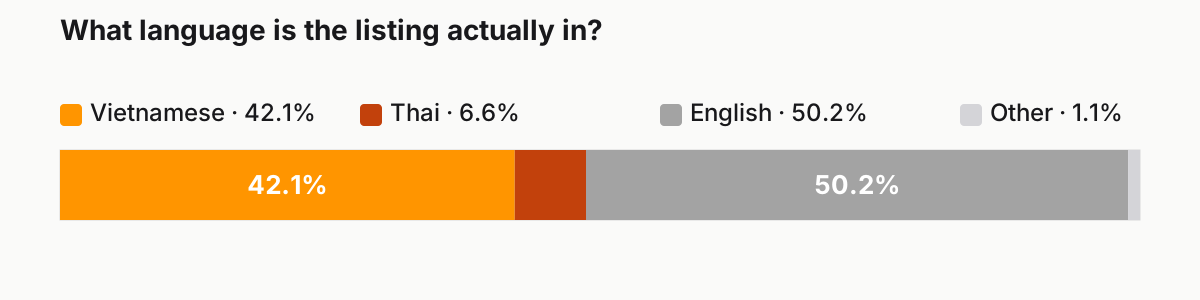
Across Da Nang, Ho Chi Minh City, Hanoi, Phuket, and Pattaya, a little under half of active rental listings are written in Vietnamese or Thai rather than English. That average hides real range: in Hanoi, most listings are Vietnamese, while in Da Nang and Phuket, English is actually the more common language, since both draw heavy foreign-agent and expat-renter traffic.
Either way, if you only read English, you're not seeing the whole board — and the half you're missing tends to be the cheaper one.
Two listings, one neighborhood
Both are one-bedroom apartments in Ngu Hanh Son, Da Nang. Both are roughly 30 square meters. Both are furnished and ready to move into.
One is listed in Vietnamese, asking $153 a month. The other is listed in English, asking $286.
Same district, same size, same month. The only real difference between them is the language they were written in — and a gap of ~$1,600 a year in what the tenant ends up paying.
How big is the gap, market by market?
Across every Southeast Asian market we track, listings written in the local language ask less than listings written in English. Here's the raw split — median monthly rent, in USD, by the language the listing was posted in:
| Market | Local-language median | n | English median | n | Gap |
|---|---|---|---|---|---|
| Da Nang | $324 | 2,683 | $515 | 5,348 | −37% |
| Ho Chi Minh City | $458 | 1,652 | $610 | 977 | −25% |
| Hanoi | $363 | 2,204 | $419 | 339 | −13% |
| Phuket | $478 | 138 | $1,219 | 436 | −61%* |
| Pattaya | $572 | 893 | $748 | 670 | −24% |
*Phuket's raw gap is the odd one out — and it's mostly not about language. Keep reading.
Is it just bigger apartments?
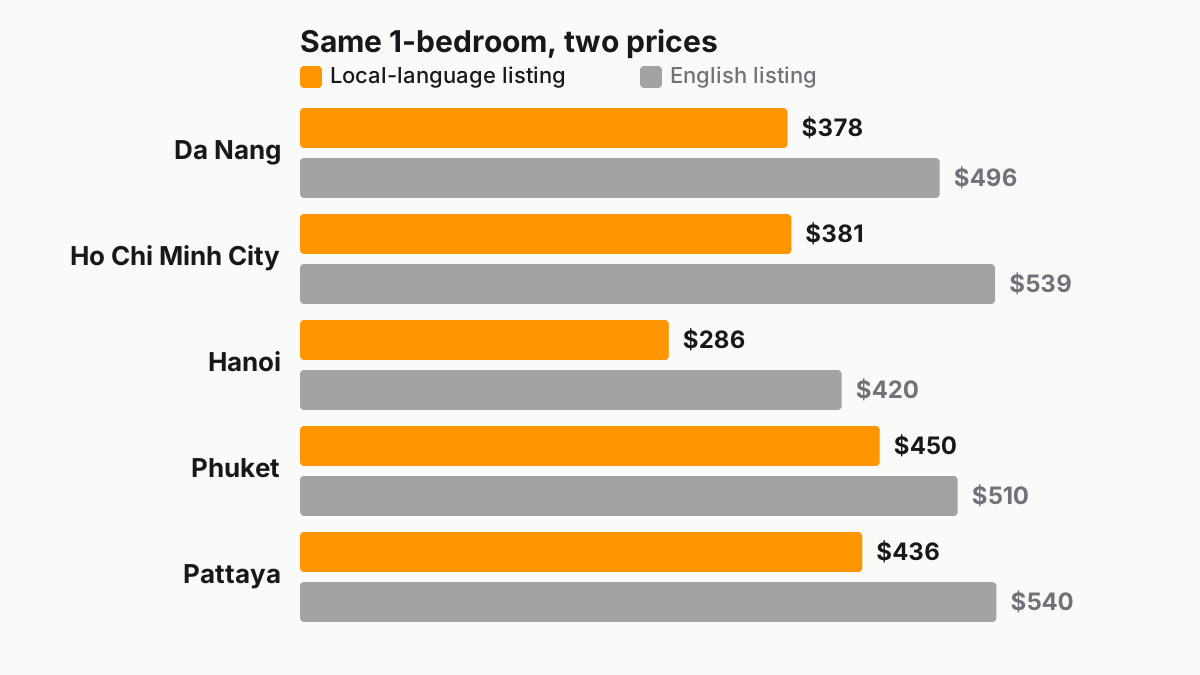
A fair objection: maybe local-language posts are for smaller, cheaper units, and English listings skew toward bigger apartments. So we controlled for size — same comparison, restricted to 1-bedrooms only:
| Market | Local 1BR median | n | English 1BR median | n | Gap |
|---|---|---|---|---|---|
| Da Nang | $378 | 579 | $496 | 2,426 | −24% |
| Ho Chi Minh City | $381 | 291 | $539 | 346 | −29% |
| Hanoi | $286 | 368 | $420 | 145 | −32% |
| Phuket | $450 | 56 | $510 | 104 | −12% |
| Pattaya | $436 | 318 | $540 | 266 | −19% |
The gap holds, and in three of five markets, it widens once size is controlled for. Phuket is the exception: its huge raw gap (−61%) mostly reflects English listings skewing toward higher-end villas and condos, not a language effect. Controlled for the same 1-bedroom, Phuket's real gap is −12% — still real, just far smaller than the raw number suggests.
We also checked whether local units are worse in other ways — smaller, unfurnished, a downgrade dressed up as a deal. In Da Nang, 1-bedrooms listed in Vietnamese average 50m²; English ones average 45m². Local units aren't smaller. Furnished rates are near-universal on both sides. Whatever's driving the gap, it isn't quality.
Is it just expat neighborhoods?
The next objection is the sharpest one: English listings cluster in expat-favorite areas (the beachfront, the nice new buildings), so of course they cost more. That's a fair point, and it deserves a real answer, not a hand-wave.
So we ran the comparison again, this time holding the district constant too — same neighborhood, same bedroom count, only the listing language differs. In Da Nang, seven districts had enough listings in both languages to compare directly. The median gap across them: 20%. Named examples:
- Hai Chau (city center) — 33% cheaper in Vietnamese
- Son Tra (peninsula, near the beach) — 20% cheaper
- Ngu Hanh Son (Marble Mountains area) — 11% cheaper
Same street, same size, same month, and the Vietnamese-language listing still asks less. Neighborhood mix doesn't explain that. Language does.
Why does the English market cost more?
The mechanism is simpler than it looks. English-language listings are written for foreign tenants — often by agents, who price for a market that can't easily comparison-shop, and add a margin for handling the inquiry, the viewing, the back-and-forth in English. Vietnamese- and Thai-language listings are written for the local market: usually a direct owner, pricing it the way they'd price it for a neighbor.
Both listings can be for the exact same building. Sometimes the exact same unit, posted twice.
None of this makes the English listing a scam — agents do real work, and some of that premium buys a smoother process. But it does mean reading only English filters you into the more expensive half of a market that has a cheaper half sitting right next to it, in a language you can't read.
What does it cost you, per year?
Take the 1-bedroom gap and multiply by twelve months. This is the number that shows up in your bank account:
| Market | Extra cost per year, reading English only |
|---|---|
| Da Nang | $1,416 |
| Ho Chi Minh City | $1,896 |
| Hanoi | $1,608 |
| Phuket | $726 |
| Pattaya | $1,248 |
In Ho Chi Minh City, that's close to two months of local-language rent — money that buys nothing except the convenience of not needing a translator.
How to access the local market
You don't need RentScout to do this — you can do it yourself:
- Translate as you browse. Google Translate's camera mode reads a screenshot of a Facebook post in seconds. It's not perfect, but it's good enough to catch price and location.
- Learn the shorthand. Vietnamese posts write price in millions — "5tr5" means 5,500,000 VND (~$215/month). Thai posts use บาท (baht) — "15000/ด." means 15,000 THB a month.
- Expect to negotiate. Asking prices, especially direct-from-owner, are opening offers. Once you know the going local-language rate for your target area, you'll know in seconds whether an asking price is fair — see our Vietnam renting guide for the deposit and contract side of it.
- A local-language listing needs the same viewing discipline as any other. Photos get reused; show up in person before you commit.
That's the honest, DIY version. The reason we built RentScout is that step one — reading the local half of the market at all — shouldn't require a translator on standby. Every listing in the feed is already translated to English, local-language and all, so the cheaper half of the market is just as visible as the expensive half.
Methodology
- Sample: active rental listings across Da Nang, Ho Chi Minh City, Hanoi, Phuket, and Pattaya, priced monthly, with a parseable USD price between $50 and $20,000. "Looking for a place" posts are excluded — this is asking-price data, not signed leases.
- Language: read from the original listing text — a listing counts as "local-language" when Vietnamese-diacritic or Thai-script characters make up a set share of its letters, and "English" when Latin characters dominate instead. It's not a perfect language check, but it's a consistent one: the same rule, applied the same way, to every listing in every market.
- Medians: computed separately for each language group, per market. The 1-bedroom cut restricts both groups to
bedrooms = 1. The district cut additionally requires the same normalized district and at least 8 listings in each language before a district counts. - What this doesn't control for: condition, floor, exact building, and anything else a photo would show that a script can't. Asking prices aren't always the price paid. Treat these as real, directional numbers — not lab-precision, but not noise either.
- Date: pulled July 2026. Rental markets move — the underlying data is re-run periodically; the numbers here are a snapshot, not a permanent fact.
FAQ
How much is a 1-bedroom apartment in Da Nang? It depends which half of the market you're reading. In our data, 1-bedrooms listed in English median at $496/month in Da Nang; the same size, listed in Vietnamese, median at $378. Actual prices vary a lot by neighborhood — browse current Da Nang listings for today's range.
Is rent negotiable in Vietnam and Thailand? Generally yes, especially renting direct from an owner rather than through an agent. The strongest negotiating position is knowing the going local-language rate for your target area before you make an offer — which is exactly the information an English-only search misses.
Why are local-language listings cheaper? Mostly because they're priced for a different audience. English listings are often posted by agents targeting foreign tenants, with pricing and margin to match; local-language listings are usually direct from the owner, priced the way they'd price it for a neighbor. Same buildings, sometimes the same unit, two different prices.
How do I see local-language listings if I can't read Vietnamese or Thai? A translation app works for casual browsing. RentScout translates every listing, local-language and English alike, into one searchable English feed, so the cheaper half of the market isn't invisible anymore.